![Future of SEO for small business — Plan A Marketing West Yorkshire]](https://gotoplana.co.uk/wp-content/uploads/2026/11/blog-pillar-hero-1024x538.jpg)
The future of SEO for small business is a question we’re asked more often than ever, usually with a note of worry. AI summaries, new Google updates and a flood of automated content have convinced plenty of owners that everything is changing at once. Some of it is. But the biggest change has been happening for years, and it’s simpler than the headlines suggest: you can no longer reliably trick Google. At its heart, SEO is now about quality. This piece looks at how we got here, what AI search really changes, and what we think comes next.
How SEO Used to Work
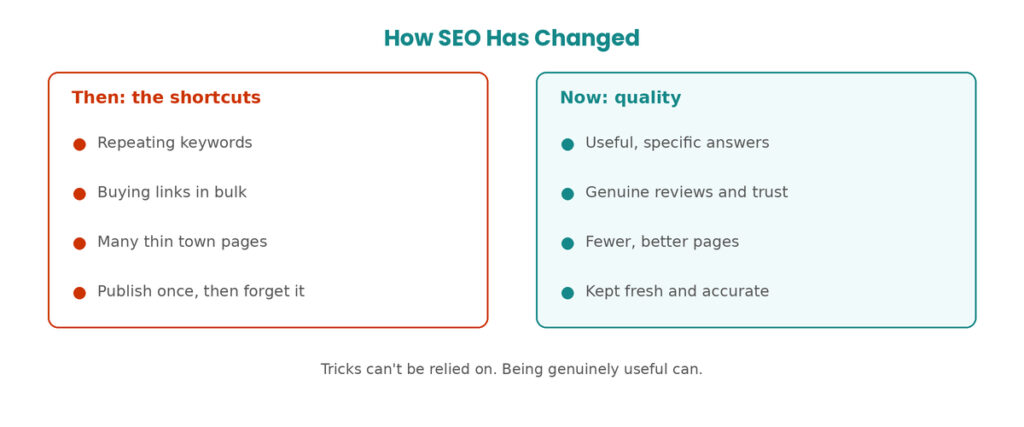
In the early days of search, getting to the top was often a matter of technique. Repeat a keyword enough times and a page could rank. Buy or swap links in bulk and a site could climb. Publish dozens of near-identical pages, one for every town and service, and some would stick. These approaches worked because search engines were relatively easy to fool, and plenty of businesses built their visibility on them. If you ran a website through those years, you may remember how much of SEO felt like finding the trick of the moment.
What Changed
Search engines got much better at judging what people actually find useful. Google now runs systems designed to reward helpful, reliable content and others designed to catch spam, and it has said repeatedly that its aim is to surface pages written for people rather than for search engines. Every tactic that relied on fooling the system has, sooner or later, been closed off.
The result is that there’s no longer a dependable shortcut. You can’t reliably convince Google a page is better than it is. You can only make the page better. Take a local engineering firm: one that explains the process it goes through, from first enquiry to finished job, is giving search engines and customers something no trick can fake. That’s a big shift, and it favours businesses that genuinely know their customers.
What “Quality” Actually Means for a Local Business
Quality is easy to say and hard to define, so it’s worth being specific. In our experience, quality content for a small business tends to be:
- Specific. It names your services, your towns and your real examples.
- Accurate. Prices, hours and details match reality today.
- Useful. It answers the questions customers ask before they ring.
- Yours. It sounds like a real business with real experience, not a template.
- Easy to use. It’s clear, quick to load and simple to act on, including on a phone.
None of these is clever. All of them take effort, which is exactly why they work.
Why AI Search Is Misunderstood
We don’t think AI search is overhyped. We think it’s misunderstood, in three ways.
It isn’t a separate game with its own secret tricks. Plenty of advice now treats AI search as a brand-new discipline. As far as we can tell, AI-powered search draws on the same web content and the same trust signals as traditional search. Making your content genuinely helpful and trustworthy helps you in both.
It doesn’t make content less important. It makes it more important. If a search tool is going to summarise or recommend businesses, it needs good material to draw on. Generic content gives it nothing worth using.
It doesn’t mean writing everything with AI. Producing content faster is not the same as producing content people value. Flooding a site with generic posts is exactly the sort of thing search systems are built to discount. Our page on AI for today’s marketer looks at using these tools sensibly.
Why This Is Good News for Small Businesses
When SEO rewarded tricks, the advantage went to whoever could afford the most technical effort. When it rewards quality, the advantage goes to whoever knows the most about their customers and can say it clearly. That’s usually you. A local business has real jobs, real customers and real knowledge of its area that a national competitor or a content tool can’t copy. You don’t need a huge budget. You need the discipline to put what you know on your website, and keep it right.
What Stays the Same
Content will still matter. The businesses that do well will be the ones whose pages are worth reading, whose Google Business Profile is accurate and whose reviews are genuine. Our guide to a holistic approach to SEO explains how these fit together, and our post on building trust and credibility on your website covers the signals that make visitors believe you.
So will freshness. A website isn’t a leaflet you print once. Prices change, services change, you finish new jobs and collect new reviews. A site that reflects all that tells visitors, and search engines, that a real, active business sits behind it. A site that hasn’t been touched for three years tells them the opposite.
Keep Looking: Search Console, Analytics and Regular Reviews
A website isn’t something you finish. Even a good one needs checking, because things change around it: pages break, rankings move, a plugin update causes a fault, or a page that used to bring in enquiries quietly stops.
Two free Google tools show you most of this. Google Search Console shows how your site appears in search, which searches bring people to it, and any technical problems Google has found. Google Analytics shows what visitors do once they arrive: which pages they read, where they leave and which ones lead to enquiries. Used together, they let you spot a problem early and see whether a change helped. Our guide to free Google tools for business covers how to get started, and if your traffic does fall suddenly, our post on a sudden drop in website traffic explains where to look first.
You don’t need to check every day. A short review each month is enough for most small businesses:
- Look for pages that have lost visitors, and ask why.
- Check Search Console for errors or warnings.
- See which pages lead to calls or enquiries, and improve those first.
- Check that your forms, phone numbers and key pages still work.
The aim is to catch small problems before they become big ones, and to make decisions from what your site is actually doing rather than from guesses.
The Quiet Danger: Poor Content Undoing Good Work
This is the part we see most often, and the part that frustrates us most. We work with a business to fix its foundations: clear service pages, an accurate profile, sound structure. Things start to improve. Then, a few months later, a batch of rushed or generic posts goes up, often AI-written and published without anyone checking them, and some of that hard work is quietly undone.
It’s rarely deliberate. Someone wants to keep the blog active, or to do something for SEO. But more content is not better content. A handful of pages that genuinely help customers will beat a stream of filler. To guard against it:
- Give one person ownership of quality, with the final say before anything is published.
- Publish less, but make each piece worth reading.
- Add real detail to everything: examples, prices, local knowledge.
- Update existing pages before adding new ones.
- Check every fact, especially anything AI has drafted.
Our guide to effective blogging covers what makes a post worth publishing.
What the Future Might Look Like
Nobody can predict this precisely, and we’d be wary of anyone who claims to. Here is how we’re thinking about the future of SEO for small business, based on what we see rather than on certainties.
- More answers inside search itself. Search is likely to keep giving direct answers to informational questions, so businesses relying on simple how-to traffic should watch it closely.
- Trust counting for more. When tools choose what to recommend, clear, consistent and verifiable information about who you are is likely to matter even more.
- Real experience as the differentiator. Anything a tool can produce in seconds, anyone can produce. What it can’t produce is your actual jobs, customers, prices and local knowledge.
- Google may matter less over time. Our view is that as AI assistants build their reputation and more people use them, a growing share of searches will start somewhere other than Google. Google is still where most searching happens today, and we’re not suggesting you ignore it. We’d simply rather you built a business that’s easy to find and easy to trust wherever people look. The things that do that, a clear reputation, genuine reviews, accurate information and helpful content, are the same things that work for SEO.
- Continued change. The details will keep shifting. The principle underneath, being genuinely useful to the people searching, hasn’t moved in years, and we don’t expect it to.
What to Do Now
- Read your main service page as a customer would, and note what’s missing.
- Improve or combine thin and duplicated pages.
- Update the basics: prices, hours, services and your Google Business Profile.
- Add real examples and local detail to your key pages.
- Make your business easy to verify beyond your own website: consistent details, genuine reviews and an up-to-date profile.
- Set one simple rule: nothing is published until someone has checked it’s genuinely useful.
- Set up Search Console and Analytics if you haven’t, and review them monthly.
- Review your key pages every few months, and whenever something changes.
Get a Second Pair of Eyes on It
If you want a clear view of where your site stands, a marketing audit carried out personally by Nick looks at your website alongside your Google Business Profile, PPC and anything else you’re running. You get a plain-English, prioritised list of what to fix first, so you can make the most of the future of SEO for small business without chasing every new headline.
Frequently Asked Questions
No. AI is changing how some search results are presented, but the pages and businesses being summarised or recommended still come from the web. Good content and trust remain the raw material. As far as we can tell, SEO is changing in emphasis rather than disappearing.
Review your key pages every few months, and update them whenever something changes: prices, services, opening hours, new work or new reviews. Small, regular updates are better than a big rewrite every few years.
No. It means content that fully answers the question the visitor came with. Some pages need a few hundred words and others need more. Padding a page to reach a word count usually makes it worse.
Give one person ownership of quality, with the final say before anything is published. Check every fact, publish less but make each piece worth reading, and update existing pages before adding new ones.
Google is still where most searching happens today. AI assistants are growing, though, and it is possible they will take a bigger share over time. Nobody knows how quickly. The sensible approach is to build a business that is easy to find and trust wherever people search, through helpful content, genuine reviews and accurate information.
They're free and, in our view, worth setting up for any business with a website. Search Console shows how Google sees your site and flags problems. Analytics shows what visitors do once they arrive. Together they help you spot issues early and see what's working.
It can be, as a way to draft or tidy wording. The value comes from what you add afterwards: real examples, local detail, accurate facts and your own voice. Publishing raw, generic output is where businesses get into trouble.
Stop guessing why you’re not getting more customers.
If your website, Google Business Profile, PPC or anything else you’re running isn’t bringing in calls, leads or sales, we can tell you exactly why. For a fixed fee of £699, Nick will personally give it a complete, plain-English once-over — hands-on and experienced, never automated — and hand you a prioritised action list of fixes.
From there, you decide how to execute it: do it yourself, let us teach your team, or have us do it for you.