If you’ve ever run your website through a free checker, you’ll know the feeling: a score, a long list of warnings and no idea where to begin. The automated SEO report vs human audit question comes down to one thing. A tool can tell you what it found. It can’t tell you what matters. Here’s what each does well, where reports fall short, and how to use both sensibly.
What an Automated Report Does Well
Automated tools are fast, consistent and good at spotting technical problems: missing page titles, broken links, slow pages, images without descriptions. They’re a useful first look, and many are free. We use some ourselves. Nothing here is an argument against them. The problem starts when a report is treated as a plan.
Where an Automated Report Falls Short
Reports tend to fail in the same few ways:
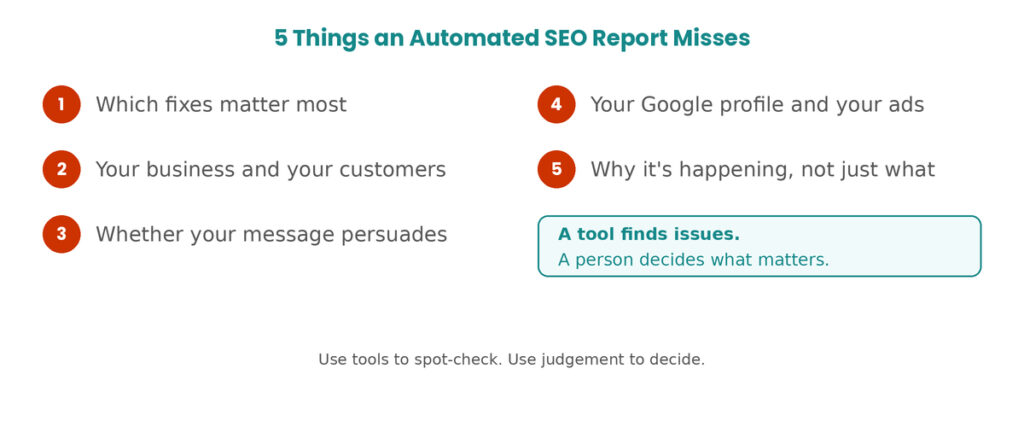
- No priorities. A trivial warning and a serious problem often sit in the same list with the same weight.
- No business context. A tool doesn’t know what you sell, who your customers are or which towns you serve.
- No judgement of quality. It can’t tell whether a page is persuasive, trustworthy or clear.
- Only the website. It doesn’t see your Google Business Profile, your advertising or how customers actually find you.
- What, not why. It tells you something is wrong, but not why it’s happening or what to do first.
What a Person Brings
Imagine a report flags thirty images without descriptions and a slow-loading page. A person looking at the same site might notice that your phone number is hard to find on mobile and your main service page never mentions the towns you cover. Those two issues cost you far more enquiries than the thirty images, and no tool would have ranked them that way. That judgement, connecting what’s measured to what actually affects customers, is the automated SEO report vs human audit difference in practice.
AI Makes This More Important, Not Less
AI tools now produce reports and recommendations that read confidently and sound authoritative. That’s useful, but it also makes errors harder to spot. A summary can be fluent and still be wrong for your business. If you’re using these tools, our page on AI for today’s marketer looks at doing so sensibly, with a person checking the output.
Questions to Ask of Any Report
Whether it comes from a tool or a person, test every recommendation with three questions. Which single fix would bring in the most enquiries? What will actually change for a customer when it’s done? And what can safely wait? If a report can’t help you answer those, it’s a list of observations, not a strategy.
Using Both Sensibly
Use free tools to spot-check your site regularly. Our guide to free Google tools for business is a good place to start. Treat what they find as a list of questions, not a to-do list. Then have someone with experience decide what’s worth fixing and in what order. SEO works best when the parts fit together, which is what our post on a holistic approach to SEO explains.
Get a Second Pair of Eyes on It
A marketing audit carried out personally by Nick is the human side of the automated SEO report vs human audit question. It looks at your website alongside your Google Business Profile, PPC and anything else you’re running, by hand, never automated. You get a plain-English, prioritised list of what to fix first, so you know which warnings deserve your time and which can wait.
Frequently Asked Questions
Frequently Asked Questions
They are usually accurate about what they can measure, such as missing page titles, broken links and slow pages. What they can't do is judge whether an issue matters for your business. A report may flag dozens of items equally, when only a few affect your enquiries.
Yes, as a starting point. Free tools are good for spotting technical problems quickly. Treat the results as a list of questions to ask, not a plan, and have someone with experience decide what is worth fixing first.
A person can judge whether your message is clear, whether your pages answer what customers actually ask, how your Google Business Profile and any advertising fit in, and which fixes will make the most difference. They can also explain why something is happening, not just that it is.
A quick check every few months is sensible, and again after any big change such as a redesign or a move to new hosting. Keep an eye on Google Search Console in between for sudden changes in traffic or errors.
Stop guessing why you’re not getting more customers.
If your website, Google Business Profile, PPC or anything else you’re running isn’t bringing in calls, leads or sales, we can tell you exactly why. For a fixed fee of £699, Nick will personally give it a complete, plain-English once-over — hands-on and experienced, never automated — and hand you a prioritised action list of fixes.
From there, you decide how to execute it: do it yourself, let us teach your team, or have us do it for you.
Book Your £699 West Yorkshire Marketing Audit
Or request an informal call back with Nick