How to Tell If Your Website Needs a Complete Redesign or Just a Fix
The website redesign vs fix question tends to arrive at the same moment for most business owners: enquiries have dried up, somebody says the site looks dated, and a redesign quote suddenly feels like the obvious answer. Sometimes it is. More often, it’s an expensive way to avoid finding out what’s actually wrong. Here’s how to tell the difference before you spend a penny.
Why the Redesign Instinct Is Often Wrong
A website that looks tired isn’t necessarily a website that’s failing. Plenty of dated-looking sites rank well and bring in enquiries, and plenty of beautiful new ones sit unseen on page four of Google. The website redesign vs fix decision should come down to what’s actually broken, not how the homepage feels after you’ve looked at it for five years.
A redesign changes appearance and structure. It does nothing for thin content, vague messaging, weak local visibility or slow follow-up, which are the usual reasons a website gets visitors but no enquiries. Worse, a careless rebuild can wipe out the rankings you’ve already earned.
Signs a Fix Is Probably All You Need
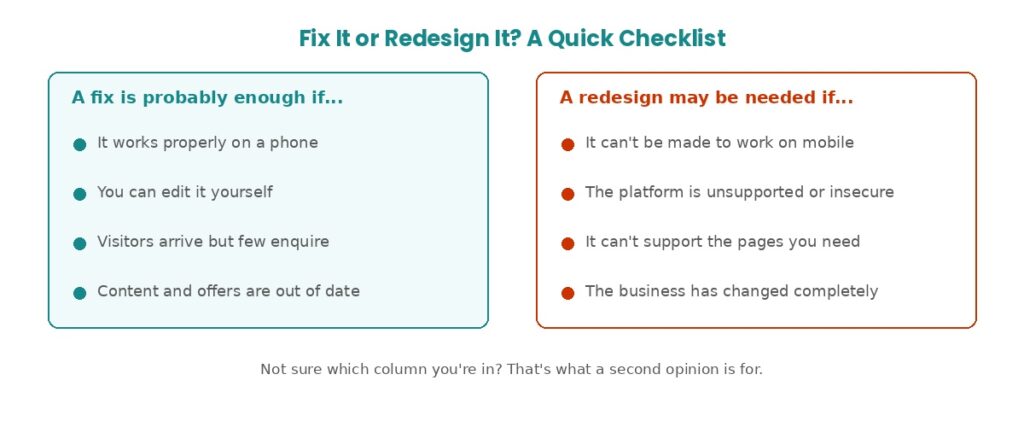
If the site loads reasonably fast, works properly on a phone, and you or your team can edit it without calling a developer, the foundations are sound. In that case, the website redesign vs fix answer is almost always a fix.
Common fixable problems include out-of-date services and prices, a homepage that doesn’t say clearly what you do and where, calls to action that are missing or buried, thin service pages, oversized images slowing things down, and a contact route that’s hard to find. These are content and structure problems. They can be corrected page by page, usually in days rather than months, without touching the design. A fix also keeps your existing URLs and rankings intact, which is a real advantage.
Signs a Redesign Is Justified
There are cases where patching won’t do. The site may be built on a platform that’s no longer supported or can’t be kept secure. It may not work properly on mobile, and the theme can’t be repaired. The structure may not let you add the pages you need, such as separate pages for each service or town. Your business may have changed so much, with new services, new customers or a new name, that the site describes a company that no longer exists. Or every small change might need a developer because nobody else can edit it.
In those cases, a rebuild is the sensible route, but it should be planned, not rushed. Our guide to building a new website covers what to settle before anyone starts designing.
The Mistake That Makes Redesigns Expensive
The costliest pattern we see is a redesign commissioned to fix a problem that was never about design. A business with poor local visibility gets a stunning new site, but nothing changes because the new pages use the same vague wording. A business with slow follow-up gets a new contact form that sends enquiries to the same unread inbox.
And a business that rebuilds carelessly, with new URLs, no redirects and old content deleted, can watch its rankings disappear overnight. If a redesign does go ahead, the new site should carry over every page that earns traffic, redirect any URL that changes, and keep the content that already works. Our guide to an SEO-friendly website explains the groundwork that protects what you’ve already built.
A Five-Minute Test Before You Decide
Open your site on your phone and ask five questions. Does it load quickly and read properly on a small screen? Can you change a page in minutes without help? Does the homepage say what you do and where within a few seconds? Can a visitor find a way to contact you without hunting for it? And is the information on it still accurate?
If you can say yes to most of those, you’re looking at a fix. If the first two are a firm no, a redesign deserves serious consideration. If you’re still not sure, that usually means you need someone to look at the facts rather than the front page.
Get a Second Opinion Before You Commit
Because the website redesign vs fix decision can mean thousands of pounds, it’s worth having someone independent look first. A marketing audit, carried out personally by Nick, looks at your website alongside your Google Business Profile, PPC and anything else you’re running, so you can see whether the problem really is the site or something around it. Either way, you end up with a plain-English, prioritised list you can hand to whoever does the work.
Frequently Asked Questions
Frequently Asked Questions
It can. Rankings often drop after a redesign when URLs change without redirects, well-performing pages are removed, or page titles and headings are rewritten carelessly. A careful rebuild keeps URLs where possible, redirects any that change, and carries over the content that already earns traffic. Plan this before design starts, not after launch.
The clearest signs are a platform that's no longer supported or can't be kept secure, a design that can't be made to work properly on phones, and a structure that won't let you add the pages you need. A dated look on its own isn't enough. If the site is technically sound and easy to edit, it can usually be refreshed without a full rebuild.
Usually, yes, because a fix targets specific problems rather than rebuilding everything. The exception is when the underlying platform is the problem, as repeated patching can cost more than a rebuild over time. The sensible approach is to identify what's actually broken before you ask for quotes for either.
Yes, and it's often the better route. Start with the changes most likely to bring in enquiries, such as a clearer homepage, stronger calls to action and updated service pages, then move on to speed and structure. Staging the work spreads the cost and lets you see what's working before you commit further.
Stop guessing why you’re not getting more customers.
If your website, Google Business Profile, PPC or anything else you’re running isn’t bringing in calls, leads or sales, we can tell you exactly why. For a fixed fee of £699, Nick will personally give it a complete, plain-English once-over — hands-on and experienced, never automated — and hand you a prioritised action list of fixes.
From there, you decide how to execute it: do it yourself, let us teach your team, or have us do it for you.