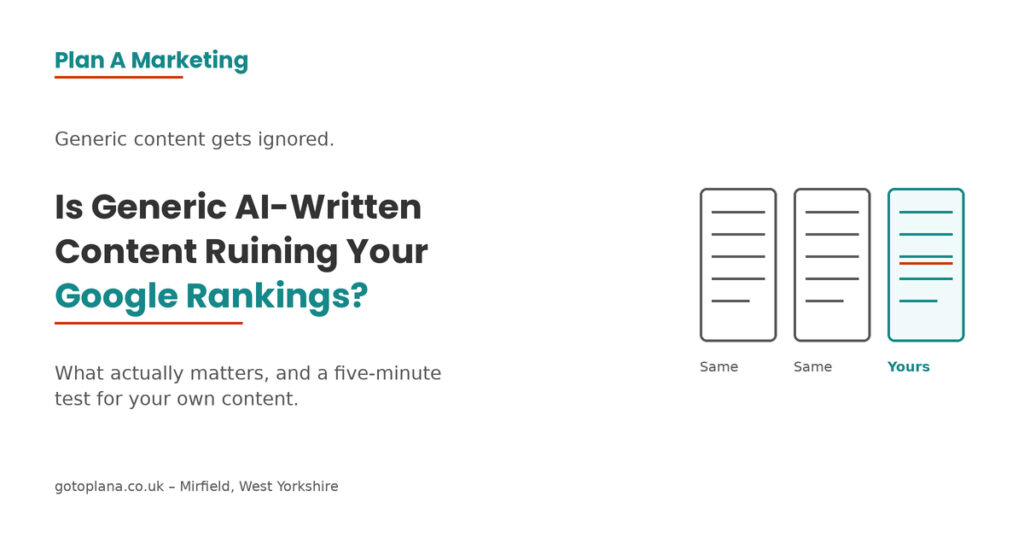
The AI content impact on SEO is one of the questions we hear most from West Yorkshire business owners right now. Tools can produce a blog post in seconds, so it’s tempting to publish a lot of them. But content that could have been written about any business, in any town, rarely gives Google or your visitors a reason to choose you. Here’s what actually matters, and how to check your own site.
Does Google Penalise AI Content?
Not simply for being AI-written. Google’s stated approach is to reward helpful content and to act against spam, including large volumes of pages produced mainly to manipulate rankings. How a page was created isn’t the test. Whether it’s useful is. That’s the real AI content impact on SEO: the tool matters far less than what you publish with it.
What “Generic” Actually Looks Like
Generic content is easy to spot once you know what to look for. It uses the same stock phrases as everyone else. It talks about “quality service” and “tailored solutions” without a single example. It never mentions the towns you serve, the jobs you’ve done or the questions customers actually ask. It repeats what the top ten search results already say, in slightly different words.
It isn’t only a small-business problem. At an engineering exhibition in Worksop last week, several people we spoke to raised the same concern: marketing teams using AI to produce poor content. In our experience, the tool is rarely the culprit. The trouble starts when the output is published without anyone shaping it.
Why It Hurts a Local Business Most
For a local business, trust is everything. Someone in Huddersfield looking for a tradesperson or adviser wants to know you understand their area and have solved their kind of problem. Bland content gives no sign of that, so visitors leave without ringing. Search engines also have little to work with: nothing that says where you operate or why you’re a better answer than the next result.
How to Use AI Without Hurting Your Rankings
AI can be a useful assistant. Use it for outlines, first drafts and tidying up your wording, then do the part it can’t:
- Add local detail. Name the towns you serve and the sort of jobs you do there.
- Add real examples. Prices, timescales, before-and-after stories and customer questions.
- Check every fact. AI tools state wrong things confidently, so verify anything specific.
- Rewrite it in your voice. If it doesn’t sound like you, customers will notice.
- Don’t publish in bulk. A few genuinely useful pages beat dozens of thin ones.
Our guide to effective blogging covers what makes a post worth reading, and our page on AI for today’s marketer looks at using these tools sensibly.
A Five-Minute Test for Your Own Content
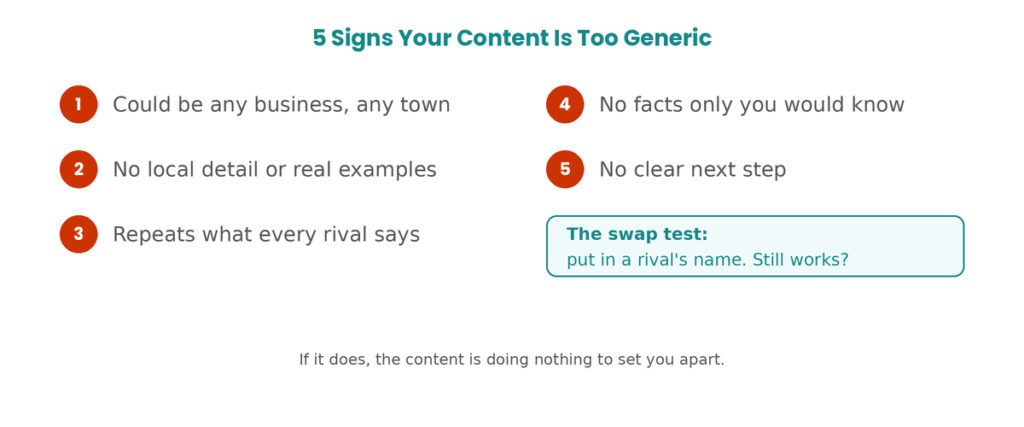
Open your most recent blog post or service page and ask five questions. If you swapped in a competitor’s name, would it still work? Is there any local detail? Is there an example or fact only you could know? Does it say something the top results don’t? And does it end with a clear next step? If you answered no to most of them, you’ve seen the AI content impact on SEO first-hand, and the fix is editing, not more publishing.
Build Trust, Not Just Page Count
Better content is only part of the picture. Visitors also need reasons to believe you, which is why building trust and credibility on your website matters as much as the words on the page.
Get a Second Pair of Eyes on It
If you can’t tell whether your content, your visibility or something else is holding your site back, a marketing audit carried out personally by Nick looks at your website alongside your Google Business Profile, PPC and anything else you’re running. You get a plain-English, prioritised list of what to fix first, so you’re not left guessing about the AI content impact on SEO for your own business.
Frequently Asked Questions
Frequently Asked Questions
Not simply because AI wrote it. Google's stated focus is on whether content is helpful, and its spam policies target mass-produced pages made to manipulate rankings, however they were created. Content that is thin, repetitive or unhelpful can struggle, whoever or whatever wrote it.
Yes, as a starting point. It can help with outlines, first drafts and tidying up your wording. The difference comes from what you add afterwards: real local detail, your own examples, accurate facts and your own voice. Publishing raw output without that is where the trouble starts.
Swap your business name for a competitor's and read it again. If it still works word for word, it is too generic. Other warning signs are no local detail, no real examples, and nothing a visitor couldn't read on a dozen other sites.
It helps in two ways. Visitors trust a business that clearly knows their area and has done similar work nearby. It also gives search engines clearer signals about where you operate and what you do, which generic wording can't provide.
Stop guessing why you’re not getting more customers.
If your website, Google Business Profile, PPC or anything else you’re running isn’t bringing in calls, leads or sales, we can tell you exactly why. For a fixed fee of £699, Nick will personally give it a complete, plain-English once-over — hands-on and experienced, never automated — and hand you a prioritised action list of fixes.
From there, you decide how to execute it: do it yourself, let us teach your team, or have us do it for you.